
We collect customer reviews, ratings, and questions for your products and your competitors'. Sources: marketplaces worldwide, online stores, and review sites. Every review is tied to a SKU and tagged by sentiment and topic. A negative spike is visible the day it appears.
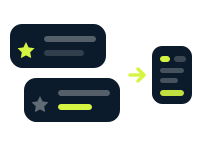
In reviews, customers spell out the reasons behind returns, ideas for your product, and competitors' weak spots. Anyone who works with physical products needs this feedback.
Understand what shoppers praise and criticize about your products. See how they react to product changes.
Catch negative spikes on your listings. Respond before ratings and rankings slip.
Mine ideas from reviews of competing products: what competitors' customers are missing, and yours too.
Use customers' own language in listings and ads. Track launch impact through rating dynamics.
Three formats to fit the task: monitoring, data matching, or custom solutions. Pricing is based on your platforms, review volume, and update frequency. You get a quote before we start.
Scheduled review collection on a regular cadence: with change history and alerts.
Monitoring plus consolidation of reviews from different platforms into a consolidated view: with matching and analytics.
Turnkey data-as-a-service: API access, DaaS, or a ready-made interface, dozens of sources, and an SLA.
How much does review scraping cost? The final price depends on clear factors, from the number of platforms to the delivery format. We send a quote and a data sample before work starts.
Describe your task and volume, and we'll get back to you with a cost estimate, timeline, and a data sample within one business day.
Scraping is the automated collection of information from websites. Review scraping is the collection of shopper ratings, reviews, and comments from marketplaces, online stores, and review sites. Software replaces manual copy-paste.
What is a scraper in plain terms? A scraper opens pages the way a regular site visitor does. It reads the code, finds the review block, and puts the data into a table. A person collects a hundred reviews in an hour. A program processes tens of thousands of pages a day without gaps.
Synonyms: web scraping, data extraction, data harvesting. We break down the terminology in our article on scraping, parsing, and crawling.
The collection process is transparent:
Then comes data processing. Duplicates are removed. Records are tied to a product and a platform. Tagging adds sentiment and topics.
Every record in the deliverable contains:
No author contact details are included. We collect only public product information, with no personal data.
Marketplaces are the main source of reviews today. We connect platforms worldwide:
Beyond marketplaces, we collect reviews from store and brand websites, review platforms, price comparison services, and forums. We work with every type of website.
Page structure and protection differ from platform to platform. We configure the scraper for each site individually and normalize the data to a single schema. Requests to every site are throttled and spread over time: collection never harms the source site. Niche platforms are added on request.
Working with reviews starts with collection. A one-time export answers the question "what are people saying right now." Monitoring shows the dynamics: how ratings shift after you rework the product, the packaging, or the listing.
What a constant stream of feedback delivers:
Complaints about a competitor's product read like a list of your advantages. Those phrases strengthen listings, ads, and sales scripts.
Ratings affect where a listing ranks in marketplace search. A fast seller reply often saves the rating. With scraping, negative feedback is visible the day it appears, not a month later. That is how monitoring works for brand reputation and sales.
Reading thousands of texts by hand takes forever. Every review is tagged automatically:
The topic set is tailored to your category. Ambiguous cases are checked by our specialists. Summaries and complex tagging are handled by AI data processing.
Off-the-shelf monitoring tools and services work from a template: fixed platforms and fields. We configure collection around the task: any sites, fields, and frequency. Our overview of scraping tools compares the approaches.
Data is delivered the way you need it: a file, a recurring feed, a dashboard, or an API. History is stored. Rating and topic dynamics for every SKU are available for any period.
This service covers collecting and tagging product reviews. Related tasks go to dedicated services:
Reviews across all source types, without a product focus, are handled by review scraping as a standalone service. All solutions for stores and brands live in the "Data for e-commerce" section.
We have been collecting product and market data since 2015. Before you commit, we'll send a free sample: reviews of your products with sentiment and topics. A project manager replies within one business day.
Short stories from review scraping projects: the data we collected and the business problems it solved.
Drop lists from dozens of marketplaces merged into one stream with metrics, age and domain history.
A full registry of .co.uk blogs and news sites plus a ready-to-use HTML corpus in S3 storage.
Drug prices and availability from pharmacy sources consolidated into one comparable market picture.
An industry-wide database of online stores with verified contacts for the sales team.
We have been collecting product and market data since 2015. Monitoring is only valuable when data arrives reliably and in the right shape.
Every review is linked to a specific product and platform, not a “brand average.”
Automatic tagging with manual review of ambiguous cases. Topics tailored to your category.
Your products and competitors' are tagged identically: the comparison is fair.
A negative spike on a SKU is visible the day it appears: by email or messenger.
A transparent process: a quote and a data sample before work starts. No hidden fees, no surprises.
Name your products or category and the platforms. A short task description is enough.
A tagged data sample, the cost, and the timeline: all before work starts.
We map SKUs to platforms and configure topics, alerts, and the schedule.
A daily review feed, alerts, and reports in the format you need.
Every product review: structured, tagged, and ready for analysis.
Every review for each SKU across all platforms: with dates, ratings, photos, and replies.
Positive/negative tagging plus topics: quality, sizing, shipping, packaging.
A spike in poor ratings on a SKU: a notification the same day.
Each product's rating over time: the impact of changes is visible immediately.
Product review scraping is part of a larger e-commerce data system. We'll assemble a solution for your task.
Prices, sellers, and product rankings on platforms worldwide.
Company and employer reviews on review platforms and employer sites like Glassdoor and Indeed.
Competitors' and categories' new products: alerts the day they appear.
Reviews of local businesses on Google Maps, Yelp, and Tripadvisor.
Review responses, negative feedback handling, and SERM.
Posts and comments about your brand on social media, from influencers, and in the press.
Can't find the answer you need? Send a request: we reply within one business day.
Marketplaces worldwide: Amazon, Walmart, eBay, Target, AliExpress, Allegro, Zalando, Mercado Libre, and more. Plus online stores, review platforms, and price comparison services. We tailor the source list to your category and add niche platforms on request.
Automatically, with manual review of ambiguous cases. Topics (quality, sizing, shipping, packaging) are tailored to your product category.
Yes. Your products and competitors' go into a single schema: review counts, complaint topics, and ratings can be compared head-to-head.
Yes. Photos, videos, seller replies, and comments are included in the deliverable whenever the platform publishes them. Analyzing that content helps pin down defects precisely.
Projects start at $150. The final price depends on the number of platforms, the volume of products and reviews, the update frequency, and the processing depth (see the factor breakdown above). We send an exact quote and a data sample free of charge before work starts.
No. We don't remove reviews or post fake ones: we collect data and surface problems. Responding to reviews and working through negative feedback is covered by a related service, reputation management.
Those are separate services. Company and employer reviews are covered by company review monitoring. Local businesses on Google Maps, Yelp, and Tripadvisor are handled by location review monitoring.
Not within this service. Posts and comments about your brand on Facebook, Instagram, TikTok, and Reddit are tracked by brand mention monitoring. Press coverage is collected by media monitoring.
Yes. Collecting publicly available information is not prohibited by law: the scraper reads the same pages any site visitor sees. We don't bypass logins, don't collect reviewers' personal data, and throttle our requests to the platforms. Every project runs under a contract.