
We collect product listings from any website: online stores, marketplaces, supplier catalogs. Names, specifications, descriptions, photos, categories, barcodes. You get a clean catalog with normalized attributes, ready to load into your system.
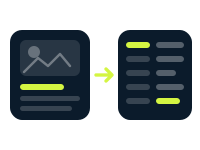
A structured product catalog serves online stores, suppliers, resellers, analysts, and ML teams. Anyone who works with product content.
Populate your catalog from a supplier's price list: specs, descriptions, and photos instead of manual entry.
Receive structured seller and supplier listings for your storefront, catalog, and matching.
Study the market's assortment: the brands, attributes, and price segments represented in a niche.
Build listing datasets with texts, attributes, and images for model training.
Three engagement models to fit the task: a one-time extraction, recurring data delivery, or a custom solution. We price against your sources, volume, and frequency — the quote arrives before work starts.
Capture a catalog once: to populate a store, migrate, or analyze.
The catalog refreshes on a schedule you set — weekly, daily, or hourly — and is delivered automatically.
Turnkey data as a service: API access, DaaS, or a ready-made interface, dozens of sources, and an SLA.
How much does product scraping cost? The total depends on clear factors, from the number of sources to the delivery format. We send a quote and a data sample before work begins.
Describe the task and volume, and we'll get back to you with pricing, timeline, and a data sample within one business day.
Scraping is the automated collection of information from web pages. Product data scraping means collecting listings from online stores, marketplaces, and manufacturer websites: names, prices, specifications, descriptions, photos.
Put simply, a scraper visits a website like a regular shopper. The program reads the page code and pulls the product attributes you need into a table. A person spends several minutes copying a single listing. A scraper processes thousands of pages per hour and sharply reduces manual errors.
Synonyms for the process: web scraping, data extraction, data harvesting. The programs themselves are called scrapers, parsers, or crawlers. We break down the terminology in our article on scraping, parsing, and crawling.
The collection process looks like this:
The data then goes through processing. Duplicates are removed. Values are mapped to a single schema. Validation filters out errors and empty fields.
The source website isn't harmed: request volume is capped and the load is spread over time. Project stages are shown in the process description below.
The complete makeup of a product listing:
Sources can be anything: online stores, manufacturer and supplier websites, B2B catalogs, PDF price lists. We scrape marketplaces worldwide:
Listing structures and anti-bot protection differ from platform to platform. We configure the scraper for each marketplace individually and map the data to a single schema.
Raw data from different sites is incompatible. One store writes “1.5 L,” another “1500 ml.” We normalize values to a single schema. That removes the usual collection headaches: duplicates, mismatched units, incomplete listings. The catalog is ready to import with no manual cleanup. We showed how this works in our article on data normalization.
The most common scenario: populating an online store with products. The store has a supplier's price list. It contains only SKUs and prices. No specifications, descriptions, or photos.
We find those products on manufacturer websites and in open sources. We build complete listings from your list. Weeks of manual data entry turn into days.
Complete listings drive sales: shoppers find products through filters and compare specifications. Empty fields cut both conversion and search traffic.
Who else benefits from product scraping:
A real example: a DIY retail chain received a catalog of 300,000 plumbing listings with photos and 42 attributes in a single schema. Category managers spotted assortment gaps and added high-demand items.
We deliver the export in your platform's format:
The file arrives by email or in cloud storage. Feeds refresh on schedule. Your CMS import module picks up the data with no rework. We'll help set up imports for popular e-commerce platforms.
Need a one-time export? We'll run it once. Need a living catalog? We'll set up recurring updates: new items, price changes, and availability arrive as deltas.
Collection tools fall into four groups:
For a review of ready-made scrapers and cloud services, see our overview of scraping tools.
We work on the fourth model — just without your involvement in development. Our team builds and maintains the scraper for every source. You get clean data, not software and its problems.
We only collect information that is openly published on the web. Out of scope:
Product information isn't restricted data. Prices, specifications, and availability are visible to every store visitor. We cover the legality question in the answers below.
Product scraping covers listing collection and catalog preparation. Adjacent tasks fall outside the service and are handled by dedicated tracks:
Page-level SEO parameters and search results are collected by the data for SEO track. Datasets for model training are prepared by data for AI and ML. Every solution for stores lives in the “Data for e-commerce” section.
We have been collecting product data for e-commerce and analytics since 2015. A project manager replies within one business day. Before we start, we'll send a free sample: several listings from your sources with every field in place.
Short stories from product scraping projects: the catalogs we built and what they did for stores and teams.
The watch catalog completed with full specifications from external sources — no manual entry.
Drop lists from dozens of marketplaces merged into one stream with metrics, age and domain history.
A full registry of .co.uk blogs and news sites plus a ready-to-use HTML corpus in S3 storage.
Drug prices and availability from pharmacy sources consolidated into one comparable market picture.
We've been collecting product and price data for e-commerce since 2015. Scraping pays off only when the data arrives reliably and in the right shape.
We capture everything: attributes, variations, photos, and documents — not just a name and a price.
Attributes are mapped to a single schema: data is comparable across sources.
Stores, marketplaces, brand websites, and PDF price lists: we collect and merge them all.
Millions of listings with images: our infrastructure is built for large catalogs.
A transparent process: a quote and sample listings before work begins. No hidden fees, no surprises.
You name the sources and the listing fields you need. A short task description is enough.
Sample listings and an exact price: all before work begins.
We collect the catalog, map attributes to a single schema, and clean out duplicates.
Export in the format you need. On a subscription, we watch quality and send updates.
A ready-to-use product catalog: structure, images, and updates in your format.
Names, attributes, descriptions, photos, categories, and variations for every product.
Attributes normalized: units, formats, and field names are consistent.
CSV, Excel, JSON, a feed, or an API: matched to your CMS, PIM, or data warehouse.
Change deltas: new items, listing edits, and discontinued products.
Product scraping is part of a larger e-commerce data system. We'll assemble a solution for your task.
We complete your listings with specifications, photos, and descriptions.
Matching identical products across platforms and price lists.
Automated translation and localization of listings for new markets.
Competitors' prices, assortment, promotions, and availability.
Prices, sellers, stock, and product rankings across marketplaces.
Product listing datasets: texts, attributes, and images.
If you don't see the answer you need, send a request: we reply within one business day.
Yes. Photos, diagrams, and documents: as archived files, as links, or uploaded straight to your storage.
Normalization maps specifications to a single schema: “1.5 L” and “1500 ml” become one value in one field. We align the schema with your CMS or PIM.
Yes — variations by size, color, and configuration are collected with a link to the parent listing.
Practically unlimited: we work with catalogs of millions of listings, images included.
Projects start at $150. The final price depends on the number of products, the number of sources, update frequency, anti-bot complexity, and extra processing (factor breakdown above). We send an exact quote and a free data sample before work begins.
Data behind logins or paywalls, personal data without a lawful basis, and third-party content for verbatim republishing. Public product information doesn't fall into those categories: prices, specs, and availability are visible to any visitor. Unsure about a source? Send us the link: we'll check it for free.
Collecting publicly available information is not prohibited by law. A scraper requests the same pages any store visitor sees. What matters is how the data is collected and how the results are used.
We don't bypass logins or paywalls, we cap request rates, and we don't republish third-party content. Price monitoring and spec collection have long been standard practice in e-commerce. We work under a service agreement.
Send a price list with SKUs and the list of fields you need. We'll find those products on manufacturer websites and in open sources, collect the specs, descriptions, and photos, and deliver a file ready for your import module. From there the catalog can refresh on a schedule: new items and changes arrive on their own.
Within product scraping we capture prices and availability as of collection time. Recurring price tracking with history and alerts is covered by online store price monitoring, and marketplaces are dissected by marketplace monitoring. Reviews and ratings are collected by product review monitoring.