
We configure an email scraper for your niche and collect company email addresses from websites, directories, and business listings. Every address is validated and tied to an organization. You get a clean database for email campaigns and B2B sales, not a dump of random addresses. We don't collect individuals' contact details.
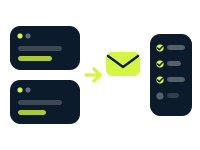
A clean email database powers the funnel from the first message to the closed deal. Valid addresses protect your sender reputation.
Contacts of potential customers in your niche and region: a database for cold outreach and ABM campaigns.
Segments for email marketing: industry, region, company size. More relevant recipients.
Databases for client projects without hunting for addresses site by site.
Company samples with contact details for surveys and market research.
Three formats to fit the task: a one-time export, recurring data delivery, or a custom solution. Pricing is based on sources, volume, and frequency. You get a quote before we start.
An email database for your niche and region, delivered once: to launch a campaign or test a hypothesis.
A database that stays alive: new companies and addresses in your niche arrive as scheduled deltas.
Turnkey data-as-a-service: API access, DaaS, or a ready-made interface, dozens of sources, and an SLA.
How much does an email scraper cost? The price depends on clear factors: from the number of sources to the size of the database. We send a quote and a data sample before work starts.
Describe your niche, regions, and target address count, and we'll get back to you with a cost estimate, timeline, and a database sample within one business day.
Email scraping, also known as email harvesting, is the automated collection of email addresses from open sources: company websites, directories, and business listings. A dedicated program crawls the pages, finds the contacts, and builds them into a database.
What is a scraper in plain terms? A scraper is a program that opens web pages and extracts the data you need from the HTML code: text, links, prices, contacts. An email scraper is tuned to extract email addresses. All the user does is set the sources and collection parameters. Manual digging through websites is no longer needed.
Why automated collection beats manual search:
Sometimes "email parsing" refers to processing incoming mail: extracting orders and requests from message text. That is a different task, handled by AI data processing.
We start from companies, not from random addresses. The process looks like this:
Every address is stored together with its source: a link to the page where it was found. The role is tagged too: a general inbox like info@ or a named employee address from the team page.
Then comes validation. We check syntax, domain existence, and mail server response. The check runs without sending an email to the recipient's inbox. Once collection is complete, you receive a database of valid addresses and a report. Typical validity is 95–98%.
A note on scope: organization records without emails are collected by business listings scraping, while locations and contacts from maps come from Google Maps scraping.
Off-the-shelf tools differ in how they are built:
An off-the-shelf tool helps with a small one-off task. Then the complications begin: source lists, dynamic websites, anti-bot protection, duplicate cleanup, validation. Anything non-standard means writing code. Our service covers the process end to end: setup, collection, verification, and support on our side. There is nothing to install.
Most scrapers are written in Python: it has the largest ecosystem of libraries for collecting and parsing data. JavaScript, PHP, Go, and C# work too. For the client, the scraper's language is secondary: what matters is the sources, the quality of the database, and the timeline. We take those questions on ourselves, so you won't have to build your own scraper.
The finished database drops straight into your CRM or email platform: we map the fields for import. Tying each address to a company enables personalization. An email pulls the company name, city, and category right into the template. Cold campaign response rates go up.
What this gives email marketing:
A note on scope. We don't send the campaigns themselves: templates, sending, and domain warm-up stay on your platform's side. A cold company database doesn't replace opted-in subscribers; it is a separate channel with its own rules. Phone numbers for calling the same companies are collected by phone number scraping.
We collect companies' contact details, not people's. The process is built without collecting personal data: we don't touch personal inboxes, social media profiles, private messages, or user activity history. We do not collect individuals' contact details.
The origin of every address is transparent. A database like this is safe for your company's reputation.
We have been collecting company and market data since 2015: more than a decade of scraping experience. The fastest way to judge the quality: a free database sample for your niche. Describe the task in a request, and we will reply within one business day.
Short stories from email scraping projects: the databases we built and the results clients achieved.
An industry-wide database of online stores with verified contacts for the sales team.
Drop lists from dozens of marketplaces merged into one stream with metrics, age and domain history.
A full registry of .co.uk blogs and news sites plus a ready-to-use HTML corpus in S3 storage.
Drug prices and availability from pharmacy sources consolidated into one comparable market picture.
We have been collecting company and market data since 2015. A database is only valuable when it is clean, complete, and current.
Every email is tied to an organization. The database is ready for personalization, not anonymous.
Syntax, domain, server response, duplicates. No junk in the database to wreck your deliverability.
Only company addresses published publicly. We don't collect personal data.
Industry, region, size. The database slices to fit your campaigns and scripts.
A transparent process: a quote and a sample database before work starts. No hidden fees, no surprises.
Name your niche, regions, and target address count.
A database sample and the exact cost before work starts.
The scraper crawls the sources. Addresses are verified and deduplicated.
The database in your format. Regular top-ups with a subscription.
A contact database ready for your sales team to work. No cleanup on your side.
Addresses tied to companies: name, website, city, category, address type.
What was checked and filtered out: syntax, domains, server response, duplicates.
CSV, Excel, JSON, or API. Fields mapped to CRMs and email platforms.
New companies and addresses in your niche arrive as scheduled deltas.
An email scraper covers only part of working with company contacts. We'll assemble the related services around your task.
Can't find the answer you need? Send a request: we reply within one business day.
Open sources only: company websites, directories, listings, maps. Contact data is collected from pages where the company itself published its email addresses. Provenance is transparent: every address links back to its source page.
Every address goes through syntax, domain, and mail server checks. The check runs without sending an email to the recipient. The database is deduplicated. Typical validity is 95–98%.
Yes. Where companies publish team pages, we collect named work addresses with job titles and flag them separately from general inboxes. We don't collect individuals' personal email addresses.
Projects start at $150. The final price depends on the number of sources, the size of the database, the update frequency, and the field set (see the factor breakdown above). We send an exact quote and a sample free of charge before work starts.
A program that collects organizations' phone numbers from open sources: directories, maps, websites. Numbers are normalized and tied to a company. We offer it as a separate service: phone number scraping. Email and phone databases are often ordered together.
A tool for collecting public posts: social media posts, comments, brand mentions. That task is handled by brand monitoring. We don't scrape private messages, chats, or mailbox contents: that is personal data.
No. We don't scrape personal profiles or closed platforms: they contain users' personal data. We collect only company email addresses from public pages where the organization listed its own contact details.
No, sending is outside the scope of this service. We collect and validate company emails: addresses, segments, and a verification report. Sending, templates, and domain warm-up stay on your side. The database is delivered in a format ready for import into popular email platforms.