
We extract the data you need from any website: marketplaces, online stores, catalogs, and web applications. You get it in structured form: products and specs, prices and stock levels, reviews and contacts. One-off export or recurring monitoring in your format: file, feed, API, or dashboard.
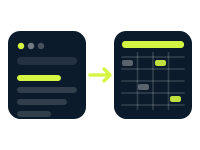
Scraping is for everyone who makes decisions based on external data. It saves the day when collecting data from other websites by hand is slow, expensive, or simply impossible.
Track competitor prices, assortment, and stock, populate product listings, and enforce MSRP compliance at retail.
Build datasets on markets, prices, and demand for reports, models, and well-grounded decisions.
Get data as a stream or via API without running your own scraping infrastructure, proxies, and maintenance.
Find companies and contacts for email outreach and calling, track ads, reviews, and brand mentions on social media.
Monitor competitor prices and rankings, new arrivals in your niches, and demand trends on Amazon, Walmart, and eBay.
Populate catalogs, price-comparison platforms, and directories with data from dozens or hundreds of sources.
Three formats to fit the task: a one-off export, recurring data delivery, or a custom solution. We price each project based on your sources, volume, and frequency, and send the quote before work starts.
Capture the data once: for research, migration, or analysis.
Data refreshes on a schedule you set, weekly, daily, or hourly, and is delivered automatically.
Turnkey data as a service: API access, DaaS, or a ready-made dashboard, dozens of sources, and an SLA.
How much does it cost to scrape a website? The final price depends on a few clear factors, from the number of sources and data volume to the delivery format. No hidden fees: we send a quote and a data sample before any work starts.
Describe your sources and the fields you need, and we'll get back to you with a cost estimate, timeline, and a sample export within one business day.
Web scraping is the automated collection of information from web pages. The result is delivered in structured form: a table, a feed, or an API response.
Put simply, a scraper program opens a website and reads the HTML code of its pages. From that code it picks out the values you need: name, price, SKU, stock level, rating. A human can do the same thing by hand. A scraper is thousands of times faster and sharply reduces manual errors.
To "scrape a website" means to crawl its pages with a program and extract data from the markup. You may also hear it called web data extraction, web harvesting, or data collection. In terms of the result, it's all one process. The programs themselves are called scrapers, crawlers, or bots.
A scraper reproduces the behavior of a regular visitor:
Then comes processing. Values are normalized to a single format, cleaned of noise, deduplicated, and validated. We throttle request rates to avoid putting load on the source site.
The end result is a clean table or a data stream. The file opens in Excel or any spreadsheet editor. The project steps are shown in the workflow below.
We build the scraper for your specific site and maintain it as layouts and anti-bot protection change. Without maintenance a collector quickly "breaks," and the data silently stops arriving. We set up completeness checks and failure alerts. You don't need your own infrastructure, proxies, or team: you receive the finished result.
Almost any publicly available information: data from online stores and marketplaces, catalogs and aggregators, classified-ad sites, maps, and search engines. Most often we collect:
For frequent tasks we offer dedicated services: online store price monitoring, marketplace scraping, product data scraping, business listings scraping, review scraping, data for AI/ML, and a domain name database.
Ready-made solutions: competitor analysis, market research, pricing, marketing and sales. Social media and Telegram are not part of this service: they're a separate practice. For brand mentions, see brand monitoring and media monitoring.
SEO scrapers are tools for collecting on-page SEO parameters. They pull title and description meta tags, headings, response codes, redirects, and site structure. Search engine data is collected separately: rankings for a keyword list, autocomplete suggestions, search volumes.
These tasks are covered by our SEO data practice: from one-off exports to SERP monitoring and SERP scraping. Read more about scraping for SEO in a dedicated article.
Brief case studies: the data we collected and the results our clients achieved.
Data from dozens of heterogeneous sources in a single valid XML feed, on schedule.
Drop lists from dozens of marketplaces merged into one stream with metrics, age and domain history.
A full registry of .co.uk blogs and news sites plus a ready-to-use HTML corpus in S3 storage.
Drug prices and availability from pharmacy sources consolidated into one comparable market picture.
We've been collecting data for e-commerce and analytics since 2015, and we know scraping is only valuable when the data arrives reliably and in the right shape.
Marketplaces, online stores, catalogs, aggregators, classifieds: we tailor the approach to every source.
Validation, deduplication, and completeness control. We make sure the export never "breaks" silently.
Site changed its layout? We fix and adapt. That's our responsibility, not your headache.
File, continuously updated feed, API, or a ready-made web interface with filters and export: whatever works for you.
Quote and data sample before work starts, a service agreement, and clear pricing with no hidden fees.
A transparent process: we scope the task and send a data sample before work starts. No hidden fees or surprises.
You send the site link and the list of fields you need. A short task description is enough.
We assess the source, estimate cost and timeline, and send a data sample in your format.
We build the scraper, agree on the format and update frequency, and put the project into production.
File, stream, API, or dashboard: you pick the channel. We maintain the pipeline and monitor quality.
The output isn't just a "downloaded website" — it's the result of real data collection: clean, structured tables and feeds ready for analysis and import into your systems.
A ready-to-use table with the fields you need: CSV, Excel, JSON, or XML in your structure.
Data refreshes on schedule and is always available in its current state.
Plug the data straight into your systems, with no manual exports or imports.
A ready-made dashboard with filters, search, export, and access control.
Normalization, deduplication, matching, and translation: the data is analysis-ready from day one.
We monitor stability, fix scrapers when sites change, and keep export quality high.
Web scraping is part of a larger data collection system. We'll assemble and configure the right setup for your task.
Daily tracking of competitor prices and assortment.
Tracking compliance with recommended and minimum advertised prices across retailers.
Reviews and ratings for reputation management and analytics.
Amazon, Walmart, eBay, and other leading marketplaces.
Product listings: specs, descriptions, prices, and photos.
Organic results, ads, and autocomplete suggestions for your search queries.
A company database for your niche: addresses and contacts from directories and maps.
We fill the gaps in your database: websites, contacts, company details.
Can't find the answer you need? Send a request: we'll reply within one business day.
Practically any: online stores, marketplaces, catalogs, aggregators, classified-ad sites, and job boards. We tailor the approach to each source, including dynamic pages and sites with anti-bot protection. Not sure about yours? Send us the link: we'll check feasibility for free.
Projects start at $150. The final price depends on the number of sources, data volume, update frequency, protection complexity, and extra processing (see the factor breakdown above). We send an exact quote and a free data sample before any work starts.
We prepare a data sample within 1–3 business days. A stable recurring feed usually goes live within a week of agreeing on the format and frequency.
A file (CSV, Excel, JSON, XML), a continuously updated feed, API access, or a ready-made web interface with filters and export. We match the fields and structure to your system.
Scraper maintenance and adaptation are included in the price of recurring monitoring; that's our responsibility. We watch data quality and promptly fix the export whenever a site changes its layout or protection.
To "scrape a website" means to crawl its pages with a program and extract data from the HTML into structured form: a table, a file, or an API response. Essentially it's the same as manually copying information from pages into a spreadsheet, only thousands of times faster and without errors. No programming skills are needed to place an order: describe the task, and we'll do the rest.
Not just web pages. We collect data from open APIs, feeds and RSS, documents (PDF, Excel, XML, JSON), maps, catalogs, and search results. Mobile app scraping exists too: that service is coming to us soon. Social media and messengers remain a separate practice. Unsure about your source? Send us the link: we'll check it for free.
Telegram scraping is the collection of public data from Telegram: channel posts and comments, messages in public chats, reactions, view counts, and member lists. It's a separate practice with its own tools and limitations: it isn't part of our web scraping service, but we're happy to discuss the task if you send a request. If you want to track brand mentions, take a look at brand monitoring and media monitoring; for an overview of the topic, read our article on social media scraping.
The classic DIY Python stack looks like this: requests for HTTP calls, BeautifulSoup or lxml for parsing HTML, Scrapy for large projects, Selenium or Playwright for pages with dynamic content. To get started, see our articles on scraping with Python, on Scrapy, and our overview of scraping libraries. Keep in mind that writing the script is only half the job: you'll also need proxies, ways around rate limits, and maintenance as layouts change. If you need results without the engineering, send us the task and we'll deliver the data turnkey.
Not completely: anything a visitor can see in a browser can be collected automatically. Rate limits, CAPTCHAs, and behavioral analysis only make data collection more expensive. Setting up such protection is outside the scope of this service, but we've analyzed the methods and their effectiveness in detail in our article on protecting a website from scraping.
Collecting publicly available information is not prohibited by law. A scraper requests the same pages any site visitor sees. What matters is how the data is collected and how the results are used.
We work carefully: we don't bypass logins or paywalls, we comply with privacy laws such as GDPR and CCPA, we throttle request rates, and we don't republish other people's content. As business practice goes, price monitoring and competitor analysis have long been the norm. We work under a service agreement.