
We collect business data from Google Maps for any category and geography. A place card includes the name, address, coordinates, phone number, website, rating, reviews, hours, and photos. We scrape any country and language, from a single neighborhood to an entire continent.
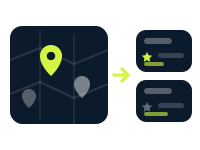
Google Maps remains the world's largest business directory — a ready source of sales leads and analytics data.
Collect every business in a category and region, with contacts. A ready-made database for entering a market.
Get data on overseas markets where no local directories exist.
Evaluate business locations: category density, neighbors' ratings, open whitespace.
Serve places, ratings, and reviews to the users of your services and studies.
Three engagement models to fit the task: a one-time export, recurring data delivery, or a custom solution. Pricing is based on categories, geography, and frequency. You get an estimate before we start.
Capture a category from the map once: for a sales database, research, or a launch.
Data refreshes on a schedule and is delivered automatically. New places and reviews are already included.
Turnkey data as a service: API access, DaaS, or a ready-made interface, dozens of sources, and SLAs.
How much does Google Maps scraping cost? Pricing comes down to clear factors, from geography to the field set. We send an estimate and a data sample before work starts.
Describe your categories and geography, and we'll get back to you with a cost estimate, timeline, and a data sample within one business day.
A Google Maps scraper is a tool that turns place cards from the map into structured data: a table, JSON, or an API response. Google Maps has long been more than navigation. It is the world's largest business directory, listing companies that appear in no other database.
"Google Maps scraper" is the umbrella term for this class of tools. We don't sell software or a browser extension. We deliver the outcome of the scraping: a ready-made database of places built for your task.
A query is built as "category + geography." Example: pizza restaurant NY 10019 finds the pizzerias in a single New York ZIP code. The robot repeats such queries across a coordinate grid and captures the full result set.
What goes into each row of the output:
A browser extension for the map runs into result limits: regular search doesn't show everything. Grid-based collection bypasses this cap, and the category is exported in full. We tune the grid and field settings to the task. You'll never have to fiddle with a settings panel yourself.
Reviews come as a separate dataset. Each review includes the score, date, and text, plus the owner's responses and comment counts where the platform shows them.
We don't collect user profiles: we take the rating information, not the author's identity. An owner response is just another comment and travels alongside the review. A one-time snapshot shows today's picture. A note on scope: continuous tracking of new reviews and reputation is handled by review monitoring.
Google Maps cards contain no email addresses. It's a frequent question and the source's main limitation. Here's how we get contacts for sales:
That turns a database of places into a database for your sales team. Collecting and validating addresses from websites is done by email scraping: the two are convenient to order together.
Cards often include links to a company's social media pages. We capture them as separate fields. Additional social links are picked up from the businesses' websites.
A note on scope: we don't collect posts, followers, or social media activity. Company profiles from directories and catalogs are covered by business directory scraping; a ready-made company database with contacts for your segment is built by company database building.
The amount of information depends on the category and region. Sales teams get the entire category with contacts: from phone numbers to website URLs. Geo analytics sees point density and open whitespace. Researchers get datasets in a single schema across countries.
We deliver the result in the format you need: CSV, Excel, JSON, a feed, or an API. The data is ready to load straight into your CRM. To get a sample for your category and city, just send a request: the sample is free.
Short stories from Google Maps scraper projects: which places we collected and the results clients achieved.
A full registry of .co.uk blogs and news sites plus a ready-to-use HTML corpus in S3 storage.
Drop lists from dozens of marketplaces merged into one stream with metrics, age and domain history.
Drug prices and availability from pharmacy sources consolidated into one comparable market picture.
An industry-wide database of online stores with verified contacts for the sales team.
We have been collecting company and market data since 2015. A map database is valuable when it is complete, clean, and fresh.
Grid-based collection across the geography. The database includes places hidden by regular search limits.
Not just name and address. Ratings, reviews, hours, attributes, menus, and photos.
One data schema across all countries and languages.
New locations, closures, and fresh reviews arrive as a delta in your feed.
A transparent process: an estimate and a data sample before work starts. No hidden fees, no surprises.
You name the categories and geography to collect.
A data sample and exact pricing before work starts.
We capture the category across a geographic grid, then clean and deduplicate.
An export in your format. On subscription, a regular delta follows.
Structured map data ready for sales and analytics. Delivered in your format.
Name, address, coordinates, contacts, rating, hours, attributes.
Review texts, scores, and dates, along with owner responses.
CSV, Excel, JSON, a feed, or an API to fit your system.
New and closed locations and rating movement, on a schedule.
The Google Maps scraper covers map data. We'll build and configure related services around your task.
If you don't see your question here, send a request: our support team replies within one business day.
Every public field of the place card: from the name, street address, and coordinates to ratings, hours, attributes, menus, and photos. Reviews come as a separate dataset with dates and scores. The scope goes beyond what any browser extension can collect.
We collect across a geographic grid rather than through search results. Category coverage is close to complete, including businesses without websites.
Yes. The data schema is identical across countries and languages, and multi-country datasets are delivered as a single set. Queries like pizza restaurant work in any market.
The map is alive: places open and close daily, and reviews arrive in a steady stream. For production use cases we recommend regular monitoring with a change delta.
Projects start at $150. The final cost depends on geography, data volume, update frequency, and extra processing (see the factors above). We send an exact estimate and a data sample before work starts.
Google Maps cards contain no email addresses. We source emails from company websites: the robot visits each contact page, and the addresses found are validated and linked to the business. That's handled by email scraping.
Yes. For each place we capture the reviews: text, score, date, owner responses, and comment counts. Every review is linked to its place card. We don't collect author profiles. Continuous tracking of new reviews is handled by review monitoring.
Yes, where they exist. A company's social media link is taken from the place card and from the business's website. We don't collect the content of the pages themselves.
An extension runs in the user's browser window and only sees the search results, with all their limits. Our process collects the category across a geographic grid, unconstrained by a single results page. No settings, proxies, or manual work: you describe the task and receive the finished result.
A CSV or Excel table, a JSON file, a feed, or an API. If something needs changing, we adapt the field set and structure to your CRM. We send the first page of the export as a free sample.